
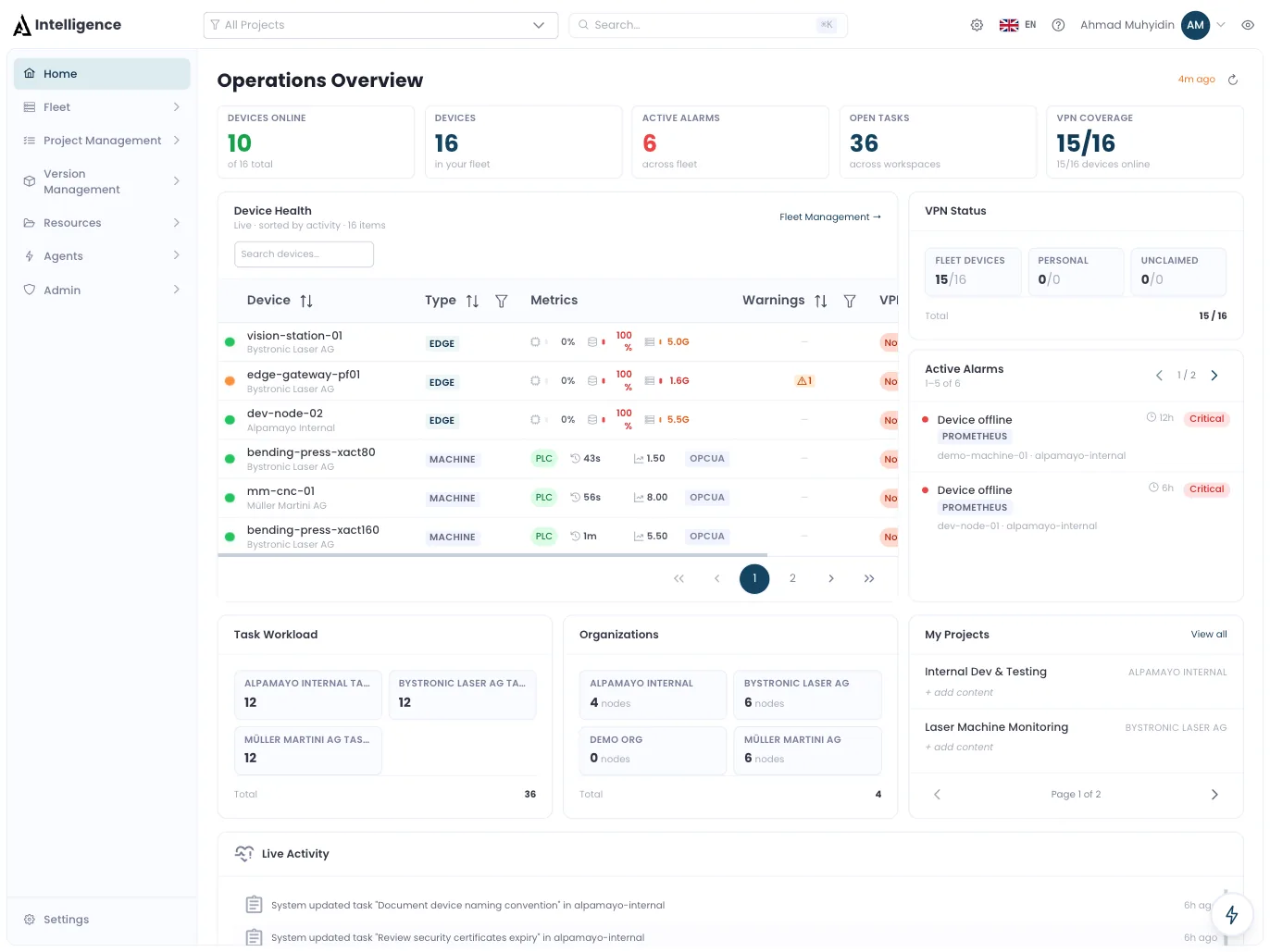

Deployment-drift engine — backend service + fleet UI with filters & saved views
Intent-based navigation: sidebar tree-menu + Fleet Overview dashboard
Resource Library: tree-browser UI, drag-drop upload, auth-protected preview, i18n
Kanban task board + Work Entries with cost tracking
OAuth2-proxy sidecar securing Grafana & internal services
Design system at /design + 32 Alp* primitives + 32 UI/UX findings (A–F)
The Problem
Alpamayo Intelligence is the operational backbone for managing organizations, fleet devices, deployments, and tasks across Alpamayo's customer network. As the platform grew, the UI accumulated friction: deployment deduplication was missing, drift surfacing was unclear, node detail was fragmented, toolbar and filter patterns were inconsistent, and the information architecture didn't match how operators actually work. At the same time, there was no shared visual language — no design system, no component standards — making every new UI piece a fresh decision.
Constraints
- [01]Swiss engineering standards — every UI change reviewed against operational accuracy, not just aesthetics
- [02]Fleet management is the primary use case — changes must map to how operators track versions, state, and drift across devices
- [03]PrimeVue + Tailwind CSS + Nuxt 4 stack — component choices constrained to the existing ecosystem
- [04]Design system must live in-app at /design — public, no auth, with a live token customizer and AI export
- [05]32 Alp* primitives must be severity-driven — consistent vocabulary across success, warning, danger, info, help, neutral
- [06]MS Teams and MS Graph integration — notification and identity infrastructure already in place
Our Approach
Conducted a structured UI/UX audit yielding 32 findings organized into 6 themes: drift surfacing (A), deployment deduplication (B), node detail tabs (C), toolbar and filters with saved views (D), information design (E), and action affordances (F). Each finding was severity-ranked and shipped as a focused change set, keeping the working platform stable throughout.
Built the design system route at /design — a public, no-auth page with a live token customizer (primary, accent, semantic, background, logo), a component showcase, sample pages, and a 'Copy for AI' button that exports a ~600-line DESIGN.md system prompt covering the full stack constraints, token system, Volt component inventory, Alp* primitive inventory, 8 composition patterns, domain glossary, and do/don't rules. Built 32 Alp* severity-driven primitives — StatusPill, StatusDot, Tag, ProgressBar, Avatar, Eyebrow, ColorPicker, PresetCard, KpiCard, and more — covering the recurring visual vocabulary of the platform.
Shipped a deployment-drift surfacing engine — a backend drift-state summary service, drift fields on Node/Machine/Deployment serializers, drift filter controls, and "Outdated" saved views in the fleet UI — so operators can see at a glance which devices have drifted from their target deployment. Redesigned the navigation to an intent-based sidebar + content layout — a tree-menu sidebar provides project-scoped navigation, while a Fleet Overview dashboard (KPI, drift, and health widgets) anchors the landing experience, with backward-compatible redirects for existing routes. Built a Finder-style Resource Library with a virtual-path hierarchy backend, tree-browser UI, any-file upload (drag-and-drop, 100 MB guard), auth-protected file preview (text, video, JSON), CSV export, and full i18n. Delivered a Kanban task board with TaskboardStore, BoardColumn, drag-and-drop, workspaces, and Work Entries with cost overview — evolving the earlier issue-tracker package into a production feature. Deployed an OAuth2-proxy sidecar (Keycloak client secret + cookie encryption) to secure Grafana and internal services behind the IdP.
Managing edge fleet devices requires robust configuration state versioning and enrollment keys to orchestrate deployment and monitor health checks across distributed industrial nodes.
Gallery
Outcome
- Fleet management platform delivering version tracking, telemetry, device state, notifications, and event streams for Alpamayo's industrial IoT customer network
- Deployment-drift surfacing engine — backend drift-state service, drift fields on serializers, filter controls, and "Outdated" saved views in the fleet UI
- Intent-based navigation redesign — sidebar tree-menu + content, Fleet Overview dashboard with KPI/drift/health widgets, project-scoped routing
- Finder-style Resource Library — virtual-path hierarchy, tree-browser UI, drag-and-drop upload (100 MB guard), auth-protected file preview (text/video/JSON), CSV export, i18n
- Kanban task board with TaskboardStore, BoardColumn, drag-and-drop, workspaces, and Work Entries + cost overview
- OAuth2-proxy sidecar deployed — Keycloak client secret + cookie encryption securing Grafana and internal services
- Design system live at /design with live token customizer and 'Copy for AI' DESIGN.md export (~600 lines)
- 32 UI/UX findings shipped across 6 themes (A–F) + 32 Alp* severity-driven primitives adopted across the platform
Why this matters
Fleet management is where Alpamayo's operational credibility lives — operators need to see which devices are drifting, which deployments are stale, and what actions are available, all at a glance. The drift engine, intent-based navigation, and Fleet Overview dashboard turn raw platform capability into operator awareness. The Resource Library and Kanban task board extend Intelligence beyond monitoring into a day-to-day operations hub. The OAuth2-proxy sidecar hardens the boundary between the platform and its supporting services. Each of these features compound — systematic UI/UX work, organized as audited findings rather than scattered improvements, means every change maps to a real operator pain point and survives Swiss review.